Monday, March 26, 2012

Towards the Affordable Steno Machine

There's been a bit of a lull in the Plover Project lately. Sadly the person who was finishing the Windows Port had to back out because her new company is getting off the ground, and Josh has mapped out the basics of the just-in-time dictionary entry feature, but he's too busy with his day job to implement it just yet. I've been paying the bills with lots of CART work, but that's meant that I've been neglecting the audio version of Steno 101 (not to mention new chapters of it), canonical categorization of the Fly dictionary, and all the other tasks assigned to me. We're also waiting on several people who have pledged to take a crack at an automated rtf-to-json dictionary converter script, but nothing from any of them yet. And we haven't heard anything from the grant we applied for, but at this point it's looking relatively likely that we might not have gotten it, which is too bad. So in a way we're in the Plover doldrums at the moment. But in another way, I'm pretty hopeful. I've been invited to give a half-day lecture and workshop on Plover and steno at PyGotham this year. Last year I gave a 35-minute overview on all the things steno could do and how far along Plover was in helping people to do them, but this year I'm going to go into a bit more depth, focusing more on accessibility and coding in the brief lecture part of the program, and then spending the rest of the time helping people learn the basics of steno on their own computers.

In order to do that, we're going to need a steno machine for each person attending the workshop, and since it's just a taste of steno, we have to make it as low-commitment as possible to hook in as many people as might be even vaguely interested. It's looking promising that we won't have to charge an extra fee for participants, which means that either the conference or I or both of us together will have to pick up the cost of the steno machines. If we were to buy 10 new Stentura Proteges, the standard entry-level student steno machine, at sticker price, we'd have to shell out a cool $17,450. That's just not gonna happen, nor should it. We're not roping these people into a lifetime commitment to stenography as a profession. We're showing them the cool things it can do and encouraging them to fit it into their life as a hobby or as an ergonomic tool in their daily work life. Clearly we've got to get that $1,745 price tag way, way, way down. From its inception, Plover has been designed to work with any qwerty keyboard that offers n-key rollover. But the staggered columns and square keys of the typical qwerty layout are tricky to adapt to the parallel columns and vertical keys of the steno layout, especially for beginners. I can write steno on an undoctored qwerty keyboard fairly easily, though I do have to sacrifice a certain amount of speed and accuracy. But I've heard a lot of would-be Plover users tell me that it's just too tricky to wrap their minds around being able to press, for instance, the "W" key and the "S" key with the same finger at the same time. It feels alien to them. Initially I tried to solve the problem with the application of leather keypads designed for steno machines, but while they helped hint at the proper alignment, they didn't have enough stiffness to really compensate for the staggered nature of the qwerty layout.

Back in 2010 I posted an entry about Abigail's brilliant stenohack. She had an old junker manual steno machine that she'd gotten for cheap, and she scavenged it for its keys, then affixed them to her sidewinder with mounting foam. It worked well for her, but it wasn't easily replicable, because old steno machines can be hard to come by, and individual steno keys sell for $7 apiece (a minimum of $154 for a complete set!) online.

So I think I've finally found a low-cost kludge that could hopefully make a big, big difference. You remember last month when I bought the iStenopad overlay, to use with the free-as-in-beer steno software that's available for the iPad? It didn't work well at all. The silicone cells were too thin and too mushy to offer anything in the way of haptic feedback, and my fingers kept sliding around all over the place, making for dismal accuracy and a very frustrating experience. But I'd spent $45 on that thing, plus $10 shipping, and it irked me that it had just been a big waste of money. So after staring at it for a few weeks, an idea occurred to me -- since it's not useful as an overlay, could it be turned into a mold?


Mann Ease Release lubricant, EasyCast clear casting epoxy, drinking straws for pipetting, plastic cups for mixing, plastic swizzle sticks for stirring, and the iStenopad overlay-cum-mold

I bought some epoxy resin casting materials and some silicone mold lubricant at an art store and gave it a try.


The keys, freshly cast in the mold (left) and after being freed from the mold (right)

It was actually really easy. Five minutes to let the lubricant settle, five more for the mixing and pipetting process, 24 hours to cure, and bingo! A full set of lovely epoxy steno keys, at pennies a set; for $25, I got enough EasyCast to make 20 or 30 sets, with resin to spare.
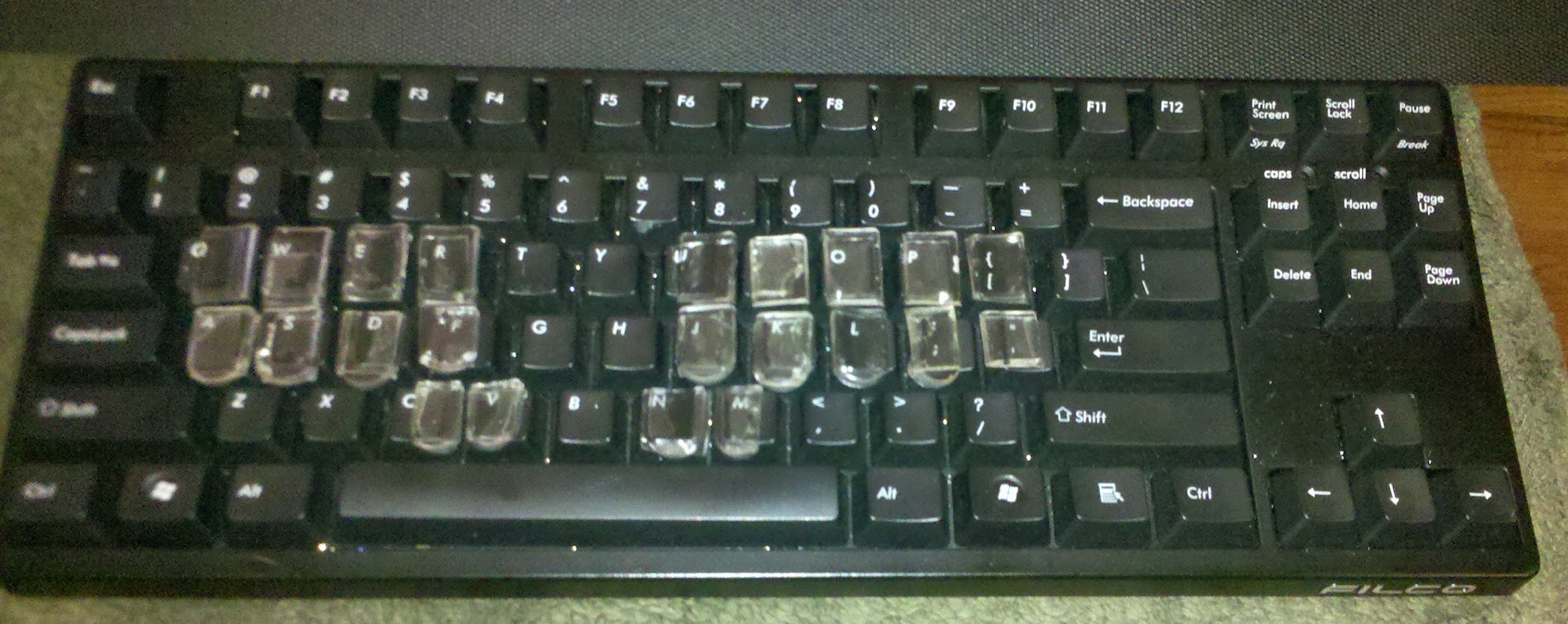

The keys wound up being a little too long to fit easily on the machine, so I had to cut them down with scissors, which fortunately was pretty easy to do.

Here's what they look like on my Filco Majestouch Tenkeyless. Originally I tried sticking them on with heavy-duty mounting foam, but they all came off way too easily, so I got some U-Glu at the drugstore, which seems to be working a lot better. It also comes in pre-cut little squares, which makes the sticking-on process a lot less tedious. So how does the altered keyboard feel? I have to say it's not half bad. I transcribed about 20 minutes of audio using it on the train home, and there was a definite improvement of comfort and accuracy over the keyboard without the keytoppers. It was really nice to have the columns lined up properly, and I found myself making fewer misstrokes due to inadvertently dropping keys. It's still not as smooth or easy as on my $4,000 Infinity Ergonomic, of course, but it's really not half bad. One thing I'd like to do is to build up the lower row a bit so that it's at the same depth as the upper row, but I'm not really sure what I can use that's both of a consistent thickness and reliably sticky. The U-Glu has been pretty tenacious so far; no lost keys after a day of banging around in my backpack. It's far from attractive, but I'm hoping to find some black pigment to mix into the next few batches, so that I won't have to look through the key toppers and smudgy glue squares to the distorted qwerty key labels beneath.

Majestouches retail at around $120, though, so that's still not quite affordable for the workshop. I'm hoping to give everyone Microsoft Sidewinder X4s, which can be purchased for around $45 a pop. On the Majestouch, I stuck the keys on fairly haphazardly. You can see that they're uneven shapes and not quite lined up. It's tricky to get them close enough together so that there's not much of a gap between rows, but not so close together that they overlap and interfere with the separate action of each key. It was also the most tedious part of the process, and took much more time and energy than the actual casting of the keys. Ideally, I'd like to be able to sell these keys as a kit, including a printable paper template that can be used to help with cutting and positioning each key in a quick, foolproof way. I know that a lot of Plover users also like alternating between steno and qwerty, so just supergluing the steno keys to the keyboard would cut out half of the keyboard's functionality for them.
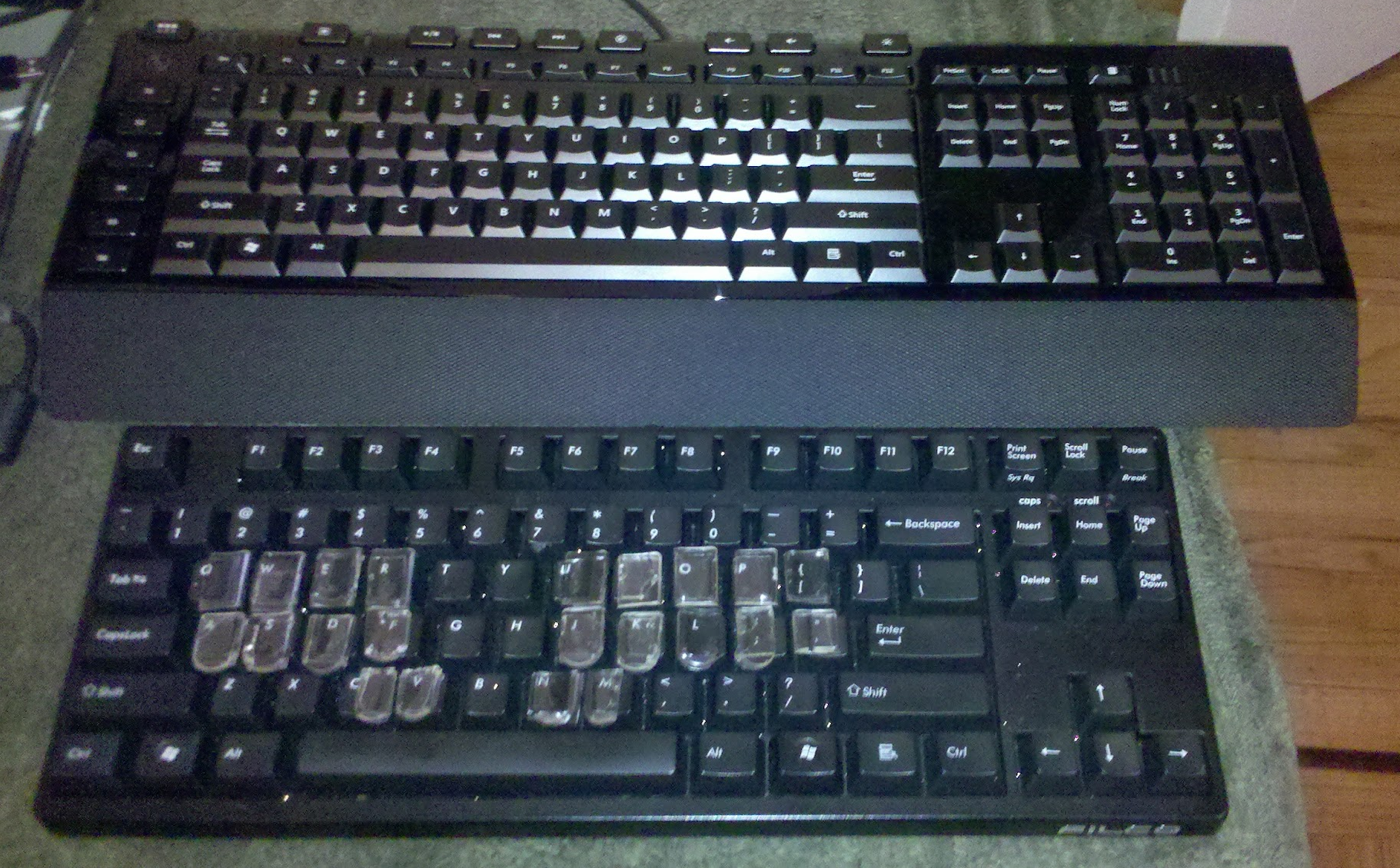


I figured a good solution both to the key positioning issue and to the reversability issue would be to glue the keys to a silicone keyboard skin rather than directly to the keyboard. I've ordered a skin that claims to be compatible with the Sidewinder X4. It hasn't arrived yet, so I don't know yet whether it'll actually fit. As you can see, the Sidewinder is a rather different size and shape from the Majestouch, so it'll definitely require more fiddling and tweaking to get the keys into position. Once that's done, though, I'm hoping to carefully record all the specs, make up a template, and then repeat the whole process about a dozen times over (hopefully streamlining it along the way) so that we'll have a nice stable of reversibly Stenofied Sidewinders available for the workshop. I'll update the blog with my progress once the skin arrives and I get the template design drawn up.

Wish me luck!

Sunday, February 26, 2012

Interactive Demo on StenoKnight Page

Regulars to the Plover Blog and Wiki might not care, but I've put an interactive demo page on my StenoKnight CART Services business website. I used it to explain how steno works in my recent Presentation for That Keith Wann Show, and I figured I might as well keep it up there for whoever might want to use it or link to it. It's basically the Plover Demo embedded in a page with some additional instructional information for people who've never encountered steno before.

Oh, and I've also added a link to the Plover Aviary on the sidebar of this blog. The Aviary has been very quiet since its inception in December, but I'm still hoping that eventually we'll build up a critical mass of steno newbies who want to talk about their learning process. Unfortunately, the board's been getting a ridiculous amount of spam -- about 20 spam posts and almost 100 spam members added per day. I've had to put all posts by new users on moderation, and I delete all new users with zero posts en masse every day or two, but if you want to join (and you're not a spammer), just write one introductory post, and as soon as it goes through I'll take you off the new users list, so that you can post unmoderated to your heart's content from that point on. Otherwise you might be in danger of getting deleted in one of my zero post pruning sessions. If you really want to lurk on the boards and don't want to post anything, just email me -- plover@ploversteno.org -- and I'll put you on the whitelist manually. As I said, the Aviary is pretty much idle these days, but as Hover Plover gets going (still no word on the grant, but once we have a conclusive yes or no we can plan our next steps) I'm hoping the place will pick up a bit.

Tuesday, February 7, 2012

Status of Current Tasks Page

I don't know how many of the people volunteering to work on the Plover Project read this blog but not the Google Group (our semi-official dev discussion group), but just in case there are a few, I'm posting this here as well as there. I just made a new page on the Plover Wiki, listing all the tasks that are currently in development (as well as the first names of the people who offered to make them happen), as well as some of the higher priority tasks from the Launchpad page that don't currently have any volunteers assigned. I hope it'll help us all keep track of each other a little better, now that Plover has expanded into this awesomely multivarious community-developed creature. If you're listed as someone assigned to a task, feel free to update the page with your current status, or if you want some help with your task, or to be unassigned to it, go ahead and note it down as well. And, of course, if you've never volunteered to help with the project but this list makes you want to, please go right ahead! We can always use more awesome coders, testers, hackers, and users at every level of expertise.

http://stenoknight.com/wiki/Status_of_current_tasks

Infinite thanks to everyone who's done such incredible work with the project, especially Pragma, Hesky, John, Jay, Gloria, and of course Plover's Primordial Demiurge, Josh. You guys are freaking amazing.

Monday, February 6, 2012

iStenopad Overlay: A Bust

Ever since iStenopad joined Plover in the free as in beer (though not as in speech) steno software ranks, I've been wanting to try it. Not because I really contemplated buying an iPad to use it with myself, but because I loved the idea of a simple overlay that could turn a touchscreen into a steno machine, and I was hoping that if it was really plausible, we could port Plover to Android and open up steno to a whole new sector of tablet owners. Sadly, it's too good to be true. It took me until now to try the app because the demo iPads you see at most electronics stores don't allow downloads from the App Store. But the computer store at the university I'm working for this semester had some unlocked iPads connected to WiFi, so I was finally able to download the app and give it a try. First I tried without the overlay. It wasn't promising. The lack of haptic feedback meant that even when I looked at my fingers, they'd tend to drift around and hit the wrong keys while missing the right ones. It was very slow, very inaccurate, and very frustrating. So I sent off for the silicone overlay ($45 plus $10 shipping), hoping that would give me enough haptic feedback to stay aligned with the keys. This morning I brought it to the computer store and spent about an hour trying to write on the iPad, with pretty dismal results. Not only were the keys still too mushy to keep my fingers from drifting off their marks, but the overlay itself kept sliding all over the place, and I wasn't able to get it to stick no matter how much I smoothed it down. I didn't try actually taping it to the iPad (since it wasn't my iPad), but even if I had, I'm not sure it would have mattered much. Unfortunately I think the keys are too close together to allow the necessary margin of error you need when dealing with such a small amount of physical feedback. If the keys had been firmer and more direct, I think I would have been able to hit my targets better, and I would have been able to tell by touch when the keys were registering and when they weren't. As it is, the only way I was able to tell which keys had been hit was by reading the display; I couldn't feel the difference between a hit or a miss based on feedback from the overlay. This is discouraging, because it makes me think that getting Plover to a mobile app won't be as simple as I had hoped. There are two things that might help to solve the problem, though. One would be using a tablet with a bigger footprint than the iPad, which would allow more separation between the keys and more margin for error. That's not completely ideal, though, because the bigger a tablet is, the less convenient it is to schlep around. Another option would be to wait until tablets with built-in locational haptics came on the market; if they buzzed just in the area underneath your finger, you wouldn't need the overlay to know where you're supposed to be pressing, or if a key has registered. A third option would be to use one's own body for haptic feedback. I experimented with wrapping the silicone overlay around my thigh and trying to write in steno without looking at the keys. It was far more successful; my brain's locational map of my leg kept my fingers from drifting around the way they did when they were touching an inanimate surface. If we could get some kind of flexible multitouch sensors going, a silicone overlay might do very nicely. But flexible multitouch panels are still pretty rare and expensive. Still, one day I'm hoping they'll be the answer to my mobile steno daydreams. In summary, the iStenopad is not anywhere close to a workable solution, and I'm kind of shocked that they're apparently selling expensive subscriptions to stenographers who want to use their iPads with their commercial steno software. I've heard from a lot of professional stenographers who tried iStenopad and then discarded it as too inaccurate and unwieldy, but I haven't heard of anyone who actually likes it enough to pay for the subscription. If you know of any, send them my way; I'd like to ask them some questions. Maybe I'm missing something. More likely, though, I think the promise of touchscreen steno has eclipsed the reality. I hope that won't always be the case, but for now it's back to the drawing board.

Sunday, January 29, 2012

#a11y unlock

Plover Blog Accessibility: Partially Upgraded.

As Plover's been getting more and more users, we've gotten a number of people wanting to learn steno who are either blind or have low vision, and who requested an audio version of the Steno 101 series. I'm happy to say I've completed the first two lessons this weekend, and I'm going to try to get the rest of them done as soon as I can, with audio versions accompanying each new Steno 101 installment as it's released. (I know I've been promising a new installment for a really long time now, and it's all mapped out and just ready to be written up; I'm just waiting for the Plover Windows Port to be finished so that all Plover users are on the same page when trying out the new features, like command strokes and numbers. Work on that is proceeding, and I'm hoping it'll be done by the end of this week, fingers crossed.)

So here are the first two installments again, now audio described by yours truly:

Steno 101: How to Do It
Steno 101: Lesson Zero

I looked around to see whether there were any accessible embedded audio players, but didn't find anything on a cursory search, so I just linked each heading to an mp3 file; you can open them in a new tab and most browsers should play them automatically. I'm very new at this, so please let me know if I need to revise any of the files, and I'll do my best to re-record them as necessary. At the end of the project, I intend to put them all into a zip file and host them on the StenoKnight servers, so people can download them as a Steno 101 audiobook if they want to learn steno on the fly. Many thanks to our blind and low vision users for giving me the spur I needed to start on this project. Enjoy the first two lessons! More coming soon.

Monday, January 16, 2012

Analytics

Graph of visits for all pages hosted on http://stenoknight.com since November, 2009 (when I started using Analytics) until today:


I just thought it was awesome and hilarious. I love the internet so much.

New Donation Page

Wow, it's been an exciting couple of days. We've already collected $200 in Plover donations, and after receiving feedback from one donor, I've made a dedicated donation page for Plover, detailing exactly where the money goes. (Right now it all goes to help our devs write code for Plover without taking too much of a financial hit when they take time away from their day jobs or freelance work; later we might use some of it as seed money to start fabricating Plover hardware, like qwerty-to-steno keyboard overlays or low-cost USB steno keyboards that plug into a computer and immediately start outputting English when they receive steno input. I've never taken any money for Plover, and I don't intend to start. My own venal reason for founding the project was to bring more people into my profession so it doesn't collapse due to the ever-increasing shortage of stenographers. If I can help raise up the next generation of captioners, transcriptionists, and steno amateurs, I'll feel more than repaid for the money I've spent getting Plover developed.) Ever since landing on Hacker News, the interest in Plover has spiked dramatically, which is glorious. Later today I'm going to try to make an entry on our wiki detailing all the various jobs that we need help with and the current state of who's working on what. Thanks for all the email and offers of support I've gotten so far! It's so inexpressibly wonderful to see this tiny little two-person project explode into a complex and multivarious international community.